

Technical Communication Courses
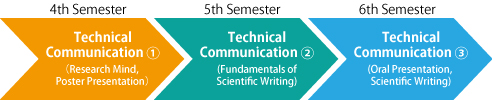
Developing technical communication skills is crucial for students pursuing majors in science and engineering as it plays a significant role in their professional success. To address this need, we offer a comprehensive technical communication program that spans three semesters during the specialized education period. This program is designed to meet the requirements of students in both the School of Agriculture and the School of Engineering, providing them with the necessary abilities to write clear and impactful scientific papers, and deliver effective oral and poster presentations.
[KIKAN Education] → [Specialized Education] → [Graduate Research]
Technical Communication 1 (Nomura and Ton)

The Technical Communication 1 class is composed of two parts.
The first half focuses on the basic techniques for scholarly communication, such as reading, thinking, presenting, and reporting with a critical mind. The course covers instructions on using a library database and reference management software. In the presentation and paper, students can explore the topic they would like to deepen their understanding of the field they are interested in studying further or exploring in their specialized field.
In the second part of this course, students will learn how to prepare a poster and engage in a poster presentation. They will acquire and improve proficiency in typing mathematical expressions and gain proficiency in utilizing advanced plotting techniques. They will also develop skills in preparing and presenting conference posters.
Technical Communication 2 (Lim)

Moving on in this second course of Technical Communication, students take on the essential question underlying scientific writing: how to effectively communicate a point in writing. To answer this question, they are given the building blocks of technical communication, which include paragraph type, noun phrase ordering, and emphatic use of vocabulary. Above all, students are invited to consider what constitutes a point and what does not –in the age of AI-assisted text generation. This consideration is particularly relevant as it helps them to understand the limitations of many such pre-existing tools from a learning standpoint.
Technical Communication 3

In this course, students are organized into groups according to their respective schools—either agriculture or engineering—and receive instruction from professors affiliated with those fields. This structure promotes a more personalized learning experience, tailoring the content to the students' academic and professional contexts. By aligning the material with their areas of study, students can engage more deeply, enhancing both the relevance and applicability of the content.
Engineering Programs (Robertson and Murugesan)
This course is designed for engineering students to develop crucial communication skills for success in the global marketplace. It is divided into two parts; the first focuses on oral communication, where students learn to prepare effectively, capture the audience's attention, and clearly present complex ideas. As a result, they gain the confidence to pitch ideas, build professional networks, and seize international opportunities. The second part emphasizes scientific writing, teaching students how to clearly communicate complex concepts in writing, manage a personal digital library of scientific publications, and summarize science news articles precisely. By the end of the course, students will be equipped with both oral and written communication skills, enabling them to excel in international engineering and research fields.
Bioresource and Bioenvironment Program (Ogino and Drummond)
This course has two parts, which build on the skills acquired in Technical Communication 1 and 2. It focuses on the requirements of communication in life science-related fields. In the first part, students will learn how to structure a scientific paper and the specific function of each section. In the second part, they will learn about the importance of scientific presentations and the differences in the graphics, words, and structure required by a scientific presentation compared to a written paper. The course ends with a formal mini-symposium where students make their final presentations and answer questions from the audience.